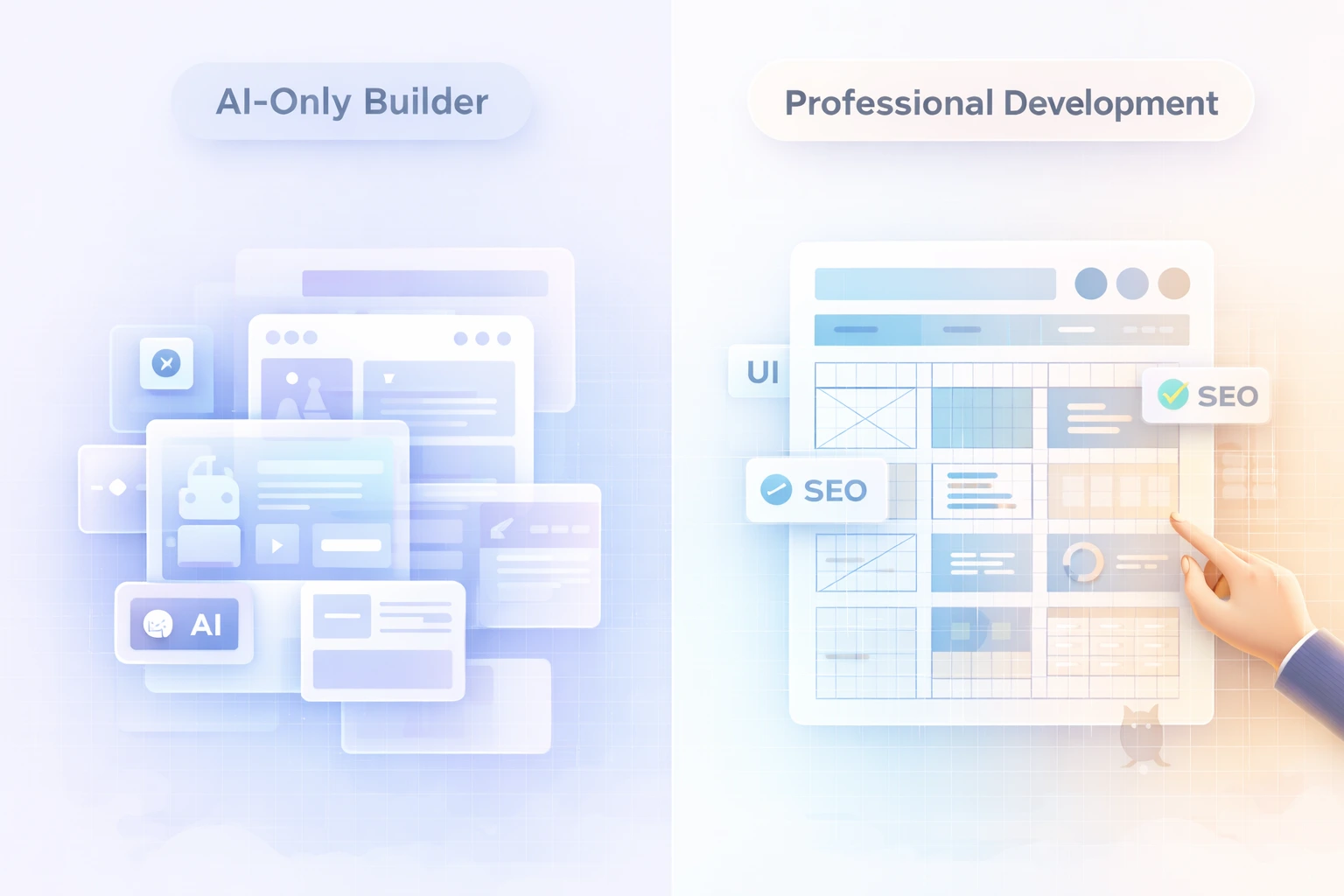
The world of web development is changing fast, and the rise of artificial intelligence has introduced powerful new tools. For businesses looking to create or update their online home, this presents a key question: should you use a quick and accessible AI website builder, or invest in professional website development? This choice impacts more than just your website design; it affects your long-term business goals. Let’s explore the differences to help you decide which path is right for you.
So, what exactly is AI-only website development? This approach uses an AI builder, a platform that leverages artificial intelligence to automate the website creation process. You provide some basic information, and the tool generates a complete web page layout, including text and images, with minimal effort.
These site builders are designed for ease of use, allowing users without technical skills to get a site online quickly. The core idea is to simplify web design by letting an algorithm handle the heavy lifting, turning your prompts into a functional website.
At their heart, AI website builders use artificial intelligence to streamline the entire development process. You typically start by answering a few questions about your business and design preferences. The AI then processes this information to generate a unique website draft for you in minutes. This technology makes web design accessible to everyone, regardless of their technical knowledge.
Many of these platforms come equipped with user-friendly features. Drag-and-drop editors allow you to adjust layouts, while built-in AI content generators can help write copy. Some even include basic SEO tools to help you get started with search engine visibility. It’s a guided experience from start to finish.
This approach offers several clear benefits:
For many business owners, the primary advantages of an AI-only approach are compelling. The most obvious benefit is speed. You can go from an idea to a live website in a remarkably short time, which is perfect for projects with tight deadlines. This rapid deployment can be a game-changer for startups and small businesses.
Another major draw is the significant cost savings. Instead of a large upfront investment, most AI builders operate on a subscription model with a low monthly price. This accessibility allows businesses on a tight budget to establish an online presence without breaking the bank. The minimal effort required also frees up your valuable time.
Here are the main gains you can expect:
While AI-only sites might not be for everyone, they excel in specific scenarios. For small businesses in India just starting, an AI-built small business website can serve as an effective digital brochure. It’s a fast and affordable way to get your name out there and provide essential information to potential customers.
These platforms are also perfect for temporary needs. Think of a landing page for a specific marketing campaign, a portfolio to showcase your work, or a site to test a new business idea (an MVP, or Minimum Viable Product). In these cases, speed and low cost are more important than long-term scalability or deep customization.
AI-only websites are a great fit for:
Professional website development is a fundamentally different process. It’s a human-led service focused on creating a strategic, custom-built asset for your business. Instead of relying on templates and automation, you partner with a human web developer or an agency to build a site from the ground up, tailored to your specific goals.
This approach prioritizes strategy, user experience, and performance. A professional team doesn’t just ask what you want your site to look like; they dig into what you need it to do. This results in custom development that is truly aligned with your brand and built for long-term growth.
The biggest differentiator in professional development is human expertise. A professional team starts with strategy, taking the time to understand your business, target audience, and competitive landscape. This ensures your website is not just a digital pamphlet but a powerful tool designed to achieve your business goals.
This strategic foundation informs every aspect of the project, especially the user experience (UX) and technical architecture. Experts design intuitive navigation and conversion-focused layouts that guide visitors toward taking action. They also plan a technical structure that is secure, fast, and ready to grow with your business, ensuring your branding is consistent and effective.
Key areas addressed by human experts include:
It’s important to know that professional development doesn’t mean ignoring technology. In fact, the smartest agencies now use a hybrid approach. They integrate artificial intelligence as a powerful assistant, not as a replacement for human strategy and engineering. This is the core of AI-assisted professional development.
In this model, developers might use AI tools to speed up coding, generate initial content drafts, or analyze data. However, every AI-generated output is reviewed, refined, and approved by a human expert. This allows the team to work more efficiently without sacrificing quality or accountability.
This balance is key. AI handles repetitive tasks, freeing up the professional development team to focus on what matters most: creating a strategic, high-performing system for your business. It’s the best of both worlds—AI for speed, humans for the critical thinking that drives results.
Professional development builds in critical elements that AI-only builders often overlook. A key one is a robust SEO structure. Professionals don’t just use basic SEO tools; they build the site with an SEO-ready architecture from the start, considering everything from internal linking to technical schema for better search engine visibility.
Scalability is another essential consideration. A professionally built site is designed to grow with you. Whether you need to add e-commerce functionality, integrate a CRM, or build out a massive blog, the underlying structure is flexible enough to handle it. This prevents you from having to start over when your business expands.
Finally, performance is non-negotiable. Professionals optimize for speed and Core Web Vitals, ensuring a smooth user experience that Google rewards with higher rankings. This involves clean code, optimized images, and careful server configuration—details that make a huge difference in the long run.
Now that we understand both approaches, let’s put them head-to-head. The choice between AI web design and professional web development comes down to a trade-off between speed and strategy, templates and true custom development. An AI builder offers a quick, templated solution, while professional websites are built for specific business outcomes.
Each has its place, but they serve very different needs. The following sections will break down the key differences in customization, strategic planning, and long-term potential to give you a clearer picture of which is the right choice for your business.
One of the most significant differences lies in customization. AI builders rely on templates. While you can change colors, fonts, and images, you are ultimately working within a pre-defined structure. This limits your ability to create a truly unique business website that perfectly reflects your brand identity.
In contrast, professional web development offers complete custom web design. A developer can build anything you can imagine, free from the constraints of a template. This allows for a tailored design and unique features that make your site stand out from competitors and provide a better experience for your users.
Here’s a quick comparison:
| Feature | AI Builder | Professional Development |
|---|---|---|
| Design Flexibility | Limited to available templates and modules. | Fully custom; design is tailored to your brand. |
| Feature Control | Restricted to the platform’s built-in features. | Unlimited; custom features can be built as needed. |
| Uniqueness | Risk of looking similar to other sites. | Creates a unique, one-of-a-kind online presence. |
| Brand Alignment | May require compromises to fit the template. | Design is built around your specific brand guidelines. |
An AI builder can create a website, but it can’t create a strategy. Professional development, on the other hand, is rooted in strategic planning. A professional team works to understand your business goals first, whether that’s generating leads, selling products, or building brand authority. This strategy then dictates every design and development decision.
This focus on goals directly impacts user experience and conversion rates. Professionals design websites to guide visitors through a carefully planned journey, encouraging them to take specific actions. From the placement of a call-to-action button to the flow of a checkout process, everything is optimized for results.
Ultimately, users can often tell the difference. A hand-coded site built with a clear strategy feels more intuitive, trustworthy, and polished. This perception of quality can directly influence a visitor’s decision to do business with you.
When you build a website, you need to think about the future. This is where the long-term potential of professional development truly shines. AI builders often have limitations on upgrades and integration capabilities. You are locked into their ecosystem, which may not support the advanced features or third-party tools you need as you grow.
A professionally developed website is built for the long haul. It’s designed to be scalable and adaptable, allowing you to add new functionalities and integrate with other systems like CRMs or marketing automation platforms seamlessly. This future-proofing saves you the significant headache and cost of a complete rebuild down the line.
Furthermore, professional development usually comes with ongoing support from a team that knows your site inside and out.
While many AI builders claim to offer SEO tools, they often fall short in delivering what’s needed for a strong online presence. The automated nature of these platforms can create significant roadblocks for visibility on search engines like Google. An AI builder can give you a website, but it can’t guarantee people will find it.
These limitations are often technical and structural, things that an average user wouldn’t notice but that search engines penalize. Let’s look at some of the specific SEO challenges that AI-only websites face.
Advanced SEO requires a level of control that most AI builders simply don’t provide. A major challenge is the lack of strategic internal linking. AI tools may create a basic site structure, but they don’t understand which pages are most important or how to link them together to pass authority and help search engines understand your content.
Another significant risk is duplicate or generic content. Since AI models are trained on existing data, they can sometimes produce content that is too similar to what’s already out there. Search engines penalize duplicate content, and generic-sounding text rarely engages users or ranks well for competitive keywords.
Common SEO issues with an AI builder include:
One of the biggest SEO limitations of AI web design is the lack of control over schema markup. Schema is a type of code that helps search engines understand the context of your content, which is crucial for appearing in “rich results” like review stars, event listings, or FAQ dropdowns in search results.
Most AI builders offer little to no ability to implement custom schema. You might get a basic, automated schema for your business address, but you can’t add the advanced, specific markup that helps you stand out. This puts you at a disadvantage against competitors who are leveraging these advanced SEO techniques.
Professional development allows for the manual and precise implementation of any type of schema. A developer can add custom code to highlight your products, services, articles, or events, giving search engines the detailed information they need to feature your site prominently.
In today’s digital world, speed matters. A slow website frustrates users and hurts your search engine rankings. Google’s Core Web Vitals are a set of metrics that measure user experience, and page speed is a major factor. Unfortunately, this is an area where many AI builder platforms struggle.
The convenience of AI site builders often comes at a hidden cost: performance. The underlying code and scripts can be bloated and inefficient, leading to slow load times. We will now explore how this happens and why it’s a problem.
Most AI builder platforms operate as closed systems. To make their drag-and-drop features work, they load a lot of extra code and scripts on every web page. This “bloat” can significantly slow down your site’s page speed, even if the page itself has very little content.
Furthermore, you typically have no hosting control. You are required to host your site on the platform’s servers, and you can’t make technical adjustments to improve performance. You have no say over the server configuration, caching, or Content Delivery Network (CDN) settings.
This lack of control means that if your site is slow, there is very little you can do about it. Without technical knowledge of how to analyze site performance, many business owners are left with a slow website and don’t even realize it’s hurting their business.
Professional development takes the opposite approach to performance. Because the site is custom-built, a developer has complete control over the code. They can write clean, efficient code that only loads what is necessary, resulting in a much faster and smoother user experience.
Professionals also have full control over the hosting environment. They can choose a high-performance server, configure advanced caching mechanisms, and optimize every aspect of the site to score well on Core Web Vitals. This meticulous attention to detail directly improves your search rankings and keeps visitors happy.
Strategies professionals use to optimize performance include:
So, must you choose between the speed of an AI builder and the quality of a human web developer? Not necessarily. The most effective solution for many businesses is a hybrid model: AI-assisted professional development. This approach combines the efficiency of AI tools with the strategic oversight of human experts.
In this hybrid approach, a professional team uses AI to accelerate parts of the web development process, like drafting professional content or generating code snippets. However, every decision is guided by human strategy, and every output is refined by a professional.
This hybrid approach allows a professional development team to work smarter and faster. For example, an AI builder might be used to quickly create different layout mockups for discussion, but a human designer makes the final decision based on user experience principles. AI might draft some initial copy, but a professional writer refines it to match the brand’s voice and strategic goals.
This is where a firm like Lumenoid Studios makes a difference. We use AI, but we don’t replace engineering, strategy, or accountability with it. The human element remains central to the process, ensuring the final product is not just fast, but also effective, scalable, and perfectly aligned with your business goals.
Ultimately, this hybrid approach delivers the best of both worlds. You get the efficiency and cost-savings that AI provides, combined with the strategic thinking, quality control, and accountability that only a professional team can offer.
A website that is perfect for your business today might not be enough for your business tomorrow. This is where the issue of scalability becomes critical. While an AI builder can get you started quickly, it can also trap you in a system that can’t grow with your business website.
The limited integration capabilities and feature sets of many AI platforms can become a major roadblock as your needs become more complex. Let’s examine some of these specific growth limitations.
As your business grows, you’ll likely need to add new features to your website. This could be anything from integrating a CRM to building a custom calculator or a customer portal. With an AI builder, you are limited to the advanced features and integrations the platform supports. If what you need isn’t on their list, you’re out of luck.
This is a stark contrast to custom development, where the possibilities are virtually limitless. A developer can build any custom workflow you need and integrate your site with almost any third-party service. This flexibility is essential for businesses that need their website to do more than just display information.
Typical pain points with AI builders include:
These scalability issues are particularly challenging for e-commerce and other high-growth businesses. While some AI platforms offer basic e-commerce features, they often lack the robust inventory management, shipping options, and payment gateway integrations that a serious online store requires. A growing business can quickly outgrow these limited capabilities.
For a high-growth business, an AI-built site can become a liability. The lack of performance tuning, limited scalability, and inability to add custom features can stifle growth and create a poor customer experience. These businesses need a platform that is as ambitious and flexible as they are.
Without deep technical knowledge, it’s easy to choose a platform that seems great at first but becomes a major problem down the road. For serious businesses like e-commerce or hotel management, a professional, scalable system is almost always the better long-term investment.
Cost is a major factor in any business decision, and web development is no exception. At first glance, AI builders seem to be the clear winner with their low initial cost. However, it’s crucial to look beyond the sticker price and consider the total cost of ownership over time.
The true cost of a website includes not just the upfront fee but also hidden expenses, maintenance, and the cost of lost opportunities. The cheapest option today may not be the most economical one in the long run.
The main appeal of an AI builder is the low upfront cost. You can get a website up and running for a small monthly fee, which is very attractive for businesses with a limited budget. This initial cost savings is a real benefit for those who just need to get online quickly.
However, these platforms often come with hidden costs. As your needs grow, you may have to pay for premium features, more storage, or better support. More importantly, the limitations of the platform can lead to “opportunity costs”—lost leads and sales due to poor SEO, slow performance, or a bad user experience.
Potential hidden costs over time include:
What happens when your business outgrows your AI-built website? This is where the real challenges begin. A website redesign on a new platform essentially means starting from scratch. Because you can’t export the design or code from most AI builders, you have to create a new website and manually migrate all your content.
This migration process can be complex, time-consuming, and expensive. It also carries the risk of hurting your SEO if not handled by a professional. The ease of getting started with an AI builder can be completely offset by the difficulty of leaving it. This “vendor lock-in” is a serious consideration.
When you need to upgrade, expect to face:
After highlighting the limitations, it’s important to be fair: AI-only website development is the right choice in certain situations. Not every project needs a full-scale, professional build. For simple, temporary, or experimental needs, an AI builder offers a combination of speed, ease of use, and low cost that can’t be beaten.
When your primary goal is to launch something quickly with minimal effort and a small budget, an AI tool can be an excellent asset. It’s about using the right tool for the right job.
AI builders are perfect for personal projects where the stakes are low. If you’re creating an online portfolio, a personal blog, or a website for a hobby, the simplicity and low cost of an AI builder are ideal. You can get a great-looking web page online without any fuss.
These tools are also invaluable for entrepreneurs who want to test a business idea. You can use an AI builder to quickly create a Minimum Viable Product (MVP) or a landing page to gauge interest in a new product or service. This allows for rapid experiments without a significant financial investment.
In these scenarios, the limitations in scalability and customization are not major concerns. The goal is speed and validation, and for that, an AI builder is an incredibly powerful tool for website creation.
Temporary campaigns and landing pages often benefit from an AI-only website development approach due to the ease of use and quick deployment. These tools enable businesses to create functional web pages with minimal upfront costs and setup time, satisfying immediate needs. However, while speed and accessibility are appealing, relying solely on AI can lead to generic structures lacking strategic depth. Sustainable growth typically requires a more professional framework that considers long-term business goals and user experience, ensuring better alignment with broader marketing strategies.
Professional website development is the better choice when businesses require customized solutions, extensive functionality, and long-term scalability. It excels in lead generation, SEO strategies, and creating a strong brand presence, ensuring sustainable growth compared to quick AI-only solutions.
Generating leads and building a strong local SEO presence are essential for sustainable success. AI website builders streamline initial setup, providing quick accessibility for businesses. However, relying solely on these tools may overlook the deeper strategies needed for long-term brand building. Effective website development involves meticulous planning and an understanding of user experience and search engine dynamics. By integrating human insight with AI capabilities, businesses can enhance lead generation techniques while ensuring their online identities are robust and adaptable to changing market needs.
Rapid advancements in AI have transformed the landscape of website creation, a development especially notable for e-commerce, hotel, and service industries in India. The usability and straightforward setup of AI builders make them attractive for businesses looking to scale quickly. However, sustainability becomes a pressing concern. While these tools provide immediate solutions, they often lack the strategic depth and customization required for long-term growth. True professional development emphasizes a balance between speed and a robust, future-proof digital presence built by real developers.
Leveraging AI technology, Lumenoid Studios enhances the website development process without undermining critical human elements like strategy and accountability. The rise of AI website builders has made online creation speedy and accessible, leading to some confusion among businesses about the ideal path to follow. While AI can simplify initial setups and reduce costs, relying solely on it does not equate to a robust, professional system. Lumenoid Studios utilizes AI to complement human expertise, ensuring sustainable outcomes that align with long-term business goals.
Mobile-first design has become essential, especially for Indian audiences, who primarily access the internet via smartphones. Prioritizing user experience (UX) ensures that websites load efficiently and are easy to navigate on smaller screens. Implementing responsive design and optimized layouts caters to the target audience, enhancing engagement. Usability testing can help identify pain points and improve interface interactions. By integrating SEO best practices within this mobile framework, businesses can create a professional system that supports ongoing visibility and meets their strategic goals.
Leveraging AI website builders offers speed and accessibility for quick setups, but many businesses find themselves confused by the implications. The core question arises: should the focus be on speed or sustainability? While AI certainly streamlines processes, relying solely on it does not equate to a professional system. Effective website creation requires a blend of AI as a tool alongside human insight to ensure robust strategy, user experience, and long-term growth, creating a sustainable digital ecosystem that aligns with business goals.
Navigating the options in today’s web development landscape can be challenging for business owners. AI website builders offer speed and efficiency, appealing to short-term needs. However, they may not provide a robust, sustainable system for long-term success. The core question becomes whether speed trumps sustainability. While AI can enhance the development process, relying solely on AI lacks the strategic depth essential for professional websites. Businesses must consider their specific needs and goals to determine the right path forward.
Determining the right approach for website development hinges on a core inquiry: what do you really need? AI website builders offer quick deployment and lower upfront costs, making them attractive for businesses seeking immediate solutions. However, it’s crucial to balance speed against sustainability. Relying solely on AI may lead to a website lacking depth in strategy, SEO performance, and user experience. Custom development provides the flexibility and growth potential essential for long-term success, ensuring that your website can evolve alongside your business goals.
A holistic system ensures that businesses don’t merely address immediate needs but also build a sustainable, long-lasting online presence. While AI website builders offer impressive speed and low upfront costs, relying solely on these tools can lead to confusion and missed opportunities. Businesses benefit most from an integrated approach that combines AI as an assistant with human expertise in strategy, user experience, and performance. This balanced synergy creates tailored solutions, catering to evolving business goals without sacrificing quality or accountability.
Choosing the right path for your website can be confusing. You need a solution that fits your budget today but also supports your goals for tomorrow. We can help you make an informed decision without the sales pressure.
Get a free website audit and we’ll tell you honestly whether an AI website is enough—or if you need a professional system.
Get Free Website Audit
Navigating the landscape of website development can be daunting, especially with the surge of AI website builders offering speedy setups and low costs. Businesses often find themselves unsure of which option aligns with their long-term goals. Acknowledging that AI alone does not equate to a robust professional system is crucial. Lumenoid Studios provides complimentary website audits to assess whether an AI solution meets your needs or if a more comprehensive, human-driven approach is warranted, ensuring you make an informed choice for your online presence.
Navigating the choice between professional and AI-only website development can be challenging for businesses. The rise of AI builders offers speed and accessibility, but often at the expense of a cohesive, sustainable web system. Understanding that AI alone cannot provide the depth of strategy, user experience, and performance optimization is crucial. A hybrid approach can leverage the strengths of both worlds, ensuring that while speed is achieved, the fundamental needs of a professional website development process are not compromised.
AI website development can be effective for serious businesses, including e-commerce and hotels, by providing quick setups and scalability. However, it may lack the customization and long-term strategies essential for brand building and customer engagement that professional development offers.
Neglecting to clearly define your business goals can lead to misaligned website development efforts. Additionally, underestimating the importance of user experience or failing to consider future scalability are critical mistakes that can hinder effectiveness and limit growth opportunities for your digital platform.
AI-assisted website development combines the strengths of human insight and AI efficiency, offering tailored solutions that pure AI or traditional methods may lack. This approach ensures better adaptability, creativity, and long-term value for businesses seeking sustainable growth in a competitive digital landscape.